Tuesday, January 8, 2013

The difference 2 months can make in bloom percentage

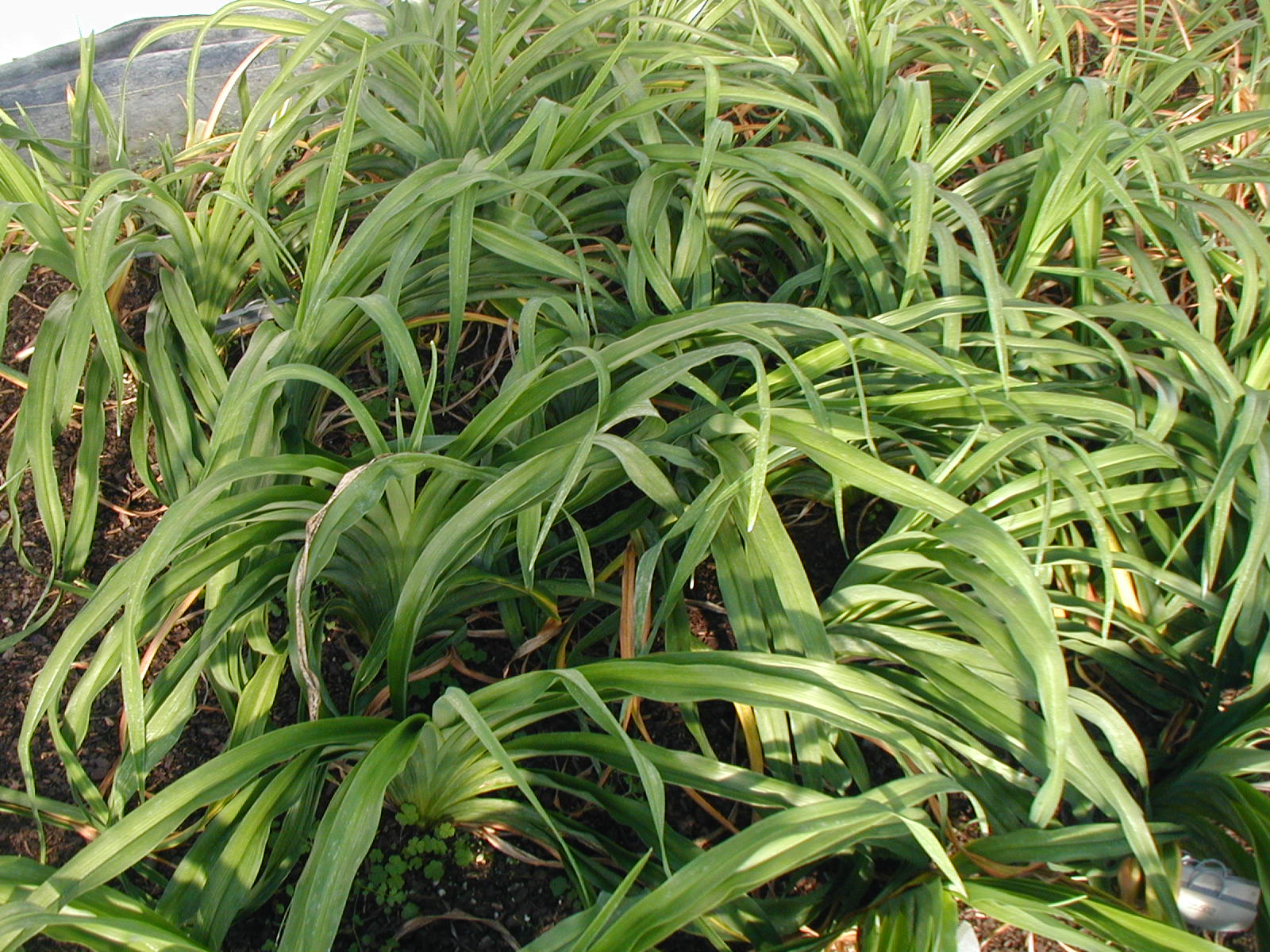
Dan Robarts asked me to show pics of the GH a year ago on today's date (first picture - where the seeds were planted Jun 1, 2011) compared to today (second picture - where the seeds were planted August 1, 2012). You can see that the pictures are taken in the identical location.Although some of the difference in the size of the plants in these pictures is because this year's crop in these particular beds has more dormants than last year's (including kids from Alpha and Omega, patterned 26712 which is out of dormant 52708, etc.) you can see the huge difference in size (note where the top of the plants are vs the top of the green marker flags) - which is the reason I got a large percentage of first year bloom last spring and why it will be much lower this year. Unfortunately, the only way to be able to plant June 1 is to use have empty beds to plant in and to use seeds made in the previous year rather than the current year. Looking at the second picture is kind of depressing, except when I remember that that is what all my pictures have looked like in early January except for last year, so there should still be a lot of bloom in April and May.


Note: you can see in the bottom picture that the bed by the wall is empty. I decided to plant fewer seeds (3000) than usual (5500) this year because of the national convention and all the work entailed in stripping out the greenhouse. That bed always has a lower percentage of bloom than elsewhere in the greenhouse. Even though that wall faces south, it shades the plants during times of the year when the sun is very low in the sky - a dumb design error on my part. I was advised to put in a short insulated wall (about 3' high) on 3 sides and a full insulated wall on the north side to save on energy. Because most people with greenhouses grow their plants in pots or trays on 3' benches it never occurred to the builders to advise me that a south wall might be a problem. In fact, one builder recommended 5 foot walls on those 3 sides to save on energy. Fortunately, I decided against that because I wanted to be able to look outside while I was working - ouch, that would have been a disaster! and very expensive to correct. For those of you who want to get into the weeds, the east side also has a large garage door that blocks some of the light, but the seedlings in the east third of the greenhouse have the highest percentage bloom rate because they get more hours of sunlight during the day than anywhere else. It is also dryer on the east end (and warmer soil because of more sun) and more spider mites because of that!

Monday, January 7, 2013

Foliage types

There has been a lot of talk on the AHS robin about foliage types, and figuring out the difference. I wrote about this earlier on the blog on January 2, 2012 and March 7, 2010 (you can go to the search box and type in those dates or just type in the word foliage). It can be really hard to tell the difference in foliage types outside, but it is quite clear in a greenhouse setting. Some things are 100% evergreen, some are 100% dormant, and semis range from 90% dormant to just 10% dormant and their foliage makes it obvious which is which. However, because I don't take the temperature in the greenhouse below 36 degrees (so as not to damage it), some things that are somewhat semi-evergreen inside may indeed be dormant when grown outside. (Note that I register the foliage type based on what I observe in the greenhouse and comment if it looks different outside).

Here are a couple of my introductions that are clearly 100% evergreen (and yes, they are hardy in the north) and were registered that way (pictures taken today). The first one is Gnashing of Teeth and the second one is Faith That Moves Mountains. Note that the foliage is erect and there is virtually no yellowing or browning at all.

The picture below is Entwined in the Vine. Although in the greenhouse it does not look evergreen this year (note the slumping leaves and browning foliage), I registered it that way because I thought it looked that way in the year before registration and because outside in the spring its foliage is mushy. 
The next picture is All Things to All Men, which is a semi-evergreen. Note yellowing but lots of green, and it looks like it might be about 70% evergreen and 30% dormant if you were using a sliding scale.
This is Spoken in Parables, which looks about midway between dormant and evergreen, and is registered as a semi-evergreen.

The picture below is Wrestling with Angels, which is almost dormant (about 90%) but not quite, so I had to register it as a semi-evergreen. Most plants this dormant do not do well in the greenhouse, so the majority of the fans are lined out outside.
Finally, a picture of Fear Not, a dormant inside and out that is now completely underground.


Sunday, October 7, 2012

2013 introductions

My website at www.springwoodgardens.com has been updated for the new 2013 introductions as well as some of the best seedlings I saw this past spring and summer. Several of the new intros are outstanding parents, most notably All Things to All Men (seedling 47607 below) which followers of this blog have read about many times. It seems to work with almost every color, and does well with eyes and solids, and with both round and triangular forms. It passes on its nice scape and reblooming qualities to many of its kids. See the website description for links to pictures of many of its kids and grandkids.

Saturday, June 23, 2012

Oh, hail!

I had been thinking that it would be good to cut off the scapes of all of the named varieties in the garden this year so they would look extra special for the national convention in July of 2013. Scapes have come up a couple of weeks earlier this year than normal because of the warm spring so hadn't yet gotten around to doing it. Last Sunday night a huge hail storm took care of it all at once,   decapitating scapes and making 5-way branching into 2-way or no-way. Here are some pics of the scapes all dinged up and decapitated, and the leaves shredded. Nothing I can do about it, so no point being stressed. Just glad no tours here this year. Many plants still haven't sent up scapes, so the season won't be a total loss. But for many plants in their last stages of evaluation, they will just have to sit there another year to get accurate statistics.


Sunday, June 17, 2012

Oh my, being a hybridizer is a lot of work!

All but about 150 of the 2012 seedlings have been taken out of the greenhouse and sent outside for further evaluation (I planted about 5400 seeds). I will keep the 150 inside for one more year to make crosses on. Yes, they are untested, but their genes are hardy, so I think it is worth the risk. Pods are in buckets of water, waiting to ripen. The tree frogs are finding it harder and harder to find places to sun themselves, but they will find a home a bed or two away in the intros I am leaving inside. We finished moving the seedlings out June 15, a record for us - probably because I eliminated about 35-40% of them before they went outside. Becasue of earlier planting last year (June 1) I was able to see a very large percentage of them bloom, and eliminated all that didn't make me smile. In order to do that in the future, I would need to hold back some of the seeds and not plant them on my normal August 1 date. Might choose to do that this year on half of them so there aren't so many to move out next year, as we will be really busy getting ready for the national.


Monday, May 28, 2012

Blue jean blue

Note the color on the sepals and closest to the throat on the petals. Seedling 37512.
Parents are 4610x3910 below.

4610 = 0608x1809. 0608 goes back to 17305, Inscribed on My Heart, Entwined in the Vine. 1809 is out of 17305x47607. 3910 = 1909x13909. 1909 = 3807x15207. 13909=1107x47607. Most of these can be seen on the website under the year I first saw them (the last 2 digits). 17305 is in this twice. See below.


Impact of heat on patterns

The first picture of 36312 is on a normal day. A couple of days later when temps went into the 90's, the white/ivory "blobs" started showing up on seedlings or were more clearly defined/accentuated. Picture 2 is 36312 the morning after the hot day. Next is 36912, 37212, 37312, 38012. The last one is 27812, shown before, but this is the most of this kind of look it has shown. I sure hope they do this outside, and that they have decent branching. These are 12 month seedlings inside.